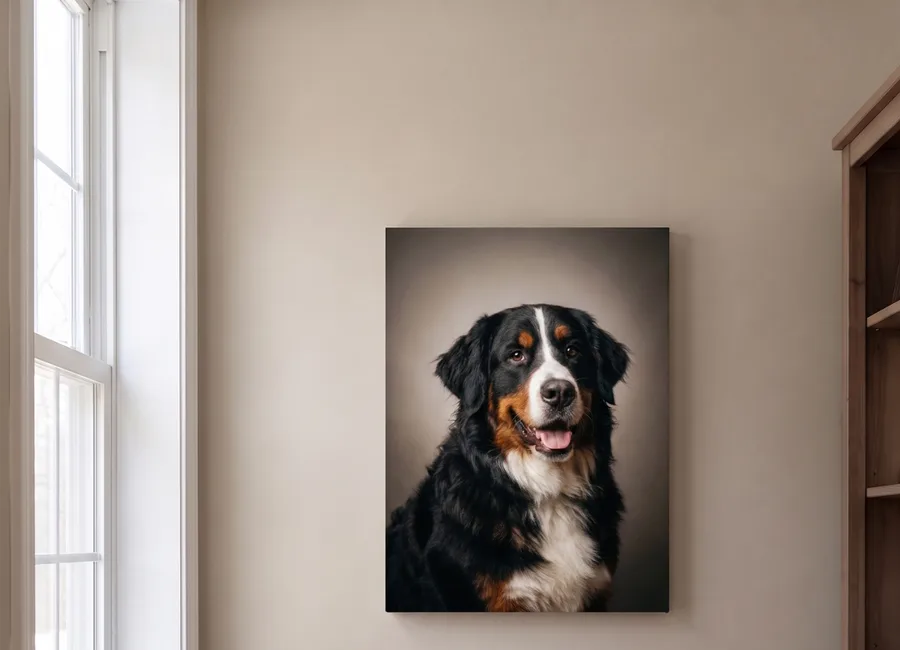
Living Room Wall Art Ideas with Pet Portraits
The best living room wall art ideas for a pet portrait are one large piece on the main wall, a row of three above the sofa or a console, a pair either side of a fireplace or mirror, a gallery wall that mixes portraits with photos, and a small portrait on a shelf. Match the idea to the wall: wide walls take rows and gallery walls, and narrow walls take a single piece or a pair.
This guide goes through each idea with real sizes, then shows how to match a portrait style to the room.
What are the best living room wall art ideas with pet portraits?
One large portrait on the main wall
One big piece does the most with the least fuss. In our size guide, 18 x 24, 20 x 24 and 24 x 24 are the living room sizes, and 24 x 30 and 24 x 36 are the statement wall sizes. Choose the largest your wall can hold with space around it.
Hang it with its centre about 57 inches from the floor, a common gallery height. Above a sofa, set the bottom edge 6 to 10 inches above the sofa back instead. The sofa case has its own guide: wall art above a couch.
A row of three
Three pieces of the same size and the same gap look planned. Three 16 x 20 in a row are 54 inches wide with a 3 inch gap. Three 11 x 14 are 38 inches wide with a 2.5 inch gap. A row suits a long wall, a console table or a bed.
A pair either side of a fireplace or mirror
Two matching pieces at the same height give a room a centre line. Use the same size, the same style and the same finish, and set them equally far from the middle. This works in a formal room where symmetry is the point.
A gallery wall with photos around a portrait
Make the pet portrait the largest piece, put it near the centre, and arrange photos and other prints around it. A 5 frame group is an 18 x 24 in the middle with four 8 x 10 around it, 39 inches wide and 24 inches tall. Our gallery wall layout guide has layouts for 3 to 12 frames, and the gallery wall planner lets you try them on a wall drawn to scale.
A small portrait on a shelf or mantel
An 8 x 10 or a 10 x 10 sits on a bookshelf, a mantel or a sideboard with no nails at all. In our size guide, a long side up to 10 inches is labelled desk or shelf. This is the easiest way to try a portrait in a room before committing a wall.
One bold colour piece
If the room is quiet, one loud piece can carry it. Pop Quad is one pet in four flat colourways, and Colour Field is your pet large and graphic against one flat block of deep colour.
Which portrait style goes with which living room?
Choose a Renaissance style if the room is traditional. The Renaissance King puts your pet in royal velvet with a golden crown on a throne, and it suits a room with dark wood, a fireplace or books.
Choose a quiet modern style if the room is plain and light. Monochrome is black and white with one hard light, and Ink and Wash is brush pen linework over one quiet wash of colour.
Choose a colour style if you want one bright thing in a calm room. Pop Quad and Colour Field both do that.
Start from the room, then pick the style. Your photo goes into whichever style you choose, and you can browse the full range on the styles page.
What should I know about canvas and framed in a living room?
Choose canvas if you want no frame and a modern look. A Premium Canvas is a gallery wrap 1.25 inches thick, and a Heirloom Gallery Canvas has 1.5 inch stretcher bars.
Choose framed if you want a finished edge. A Framed Poster comes in black, white or red oak, and Luxury Framed comes in 15 finishes with no mount, so the portrait fills the frame.
Both are ready to hang. Premium Canvas arrives with mounting brackets included, and Luxury Framed arrives with the hanging wire fitted. For a longer comparison, read framed or canvas pet portraits.
How do I plan a living room wall before I order?
- Measure the wall and the furniture under it.
- Decide the idea: single, row, pair or gallery wall.
- Cut paper to the size you are thinking of and tape it up for a day.
- Order when the paper still looks right on the third day.
Each style is its own portrait, so an idea with three styles means three portraits. For each one you upload a photo and pick a style, and the looks come back within 24 hours. Nothing prints until you approve. Free standard shipping to the US and Canada takes 7 to 10 business days after approval, and several pieces may arrive in several boxes.
Where to go from here
- Dog and cat wall art in one place: home decor.
- Planning a group of frames: gallery wall layout.
- A wall made of your own dog: dog gallery wall ideas.
- Going up the stairs: staircase gallery wall.
Frequently Asked Questions
What size wall art works in a living room?
Our size guide labels 18 x 24, 20 x 24 and 24 x 24 as living room sizes, and 24 x 30 and 24 x 36 as statement wall sizes. These labels are a suggestion about fit, so measure your own wall first.
Should a pet portrait go above the sofa?
It can. The wall above a sofa is easy to see from across the room, so a pet portrait there is noticed first. Because our upright sizes top out at 24 inches wide, a pair or a row of three usually fits a sofa better than one piece.
Can I mix pet portraits with other art in the living room?
Yes. A pet portrait works well as the anchor of a gallery wall with photos and prints around it, as long as the gap between frames stays the same.
Canvas or framed for a living room?
Canvas has no frame and suits modern rooms, while a framed print suits a more traditional room. Both come ready to hang, so the choice comes down to the look you want.
Start your portrait and choose a style for your living room.
You Might Also Enjoy
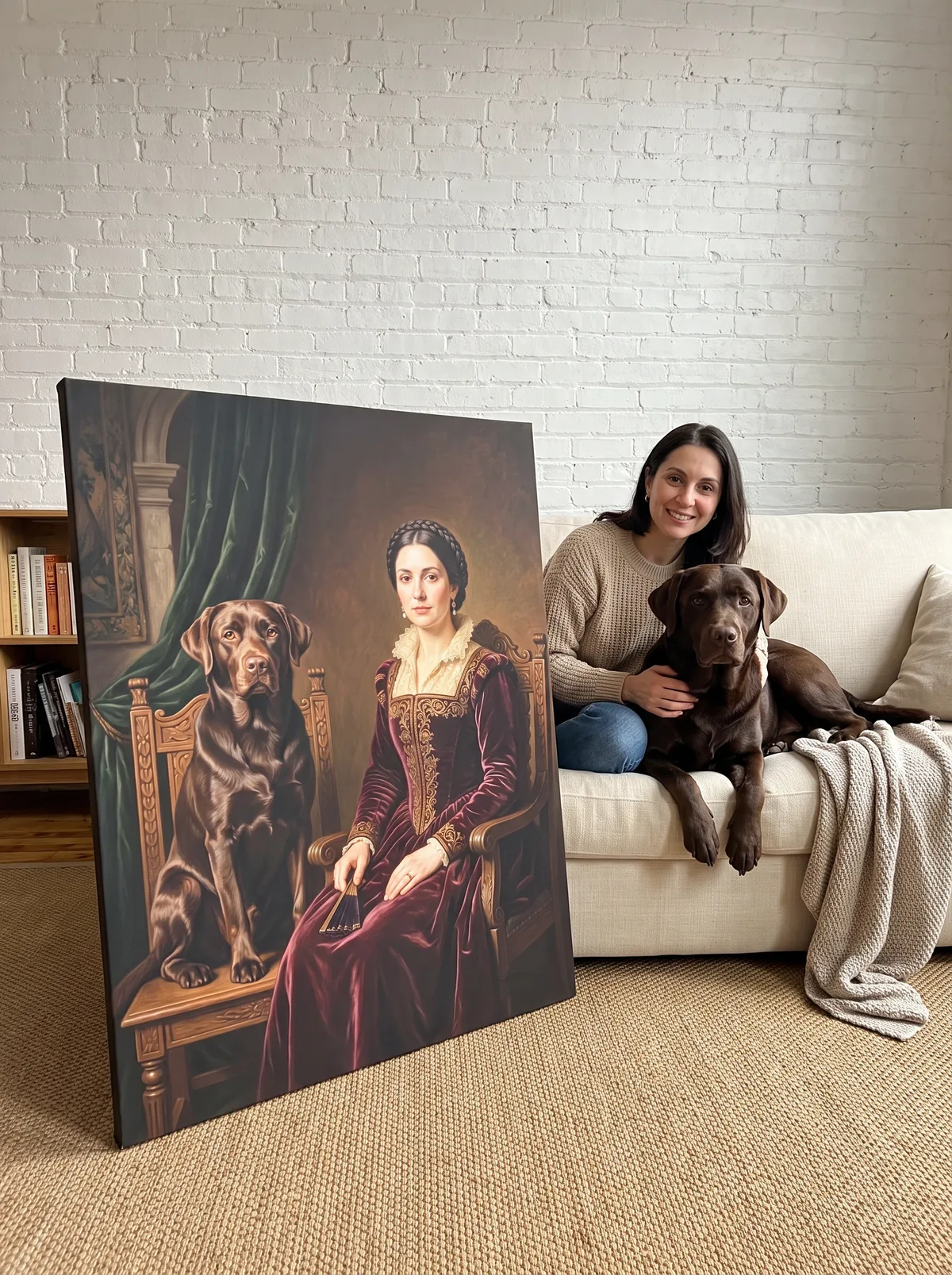
Wall Art Above Couch: Sizes and Layouts
Wall art above a couch: make it two-thirds to three-quarters of the sofa width, hung 6 to 10 inches above the back. Real sizes for 72, 84 and 96 inch sofas.
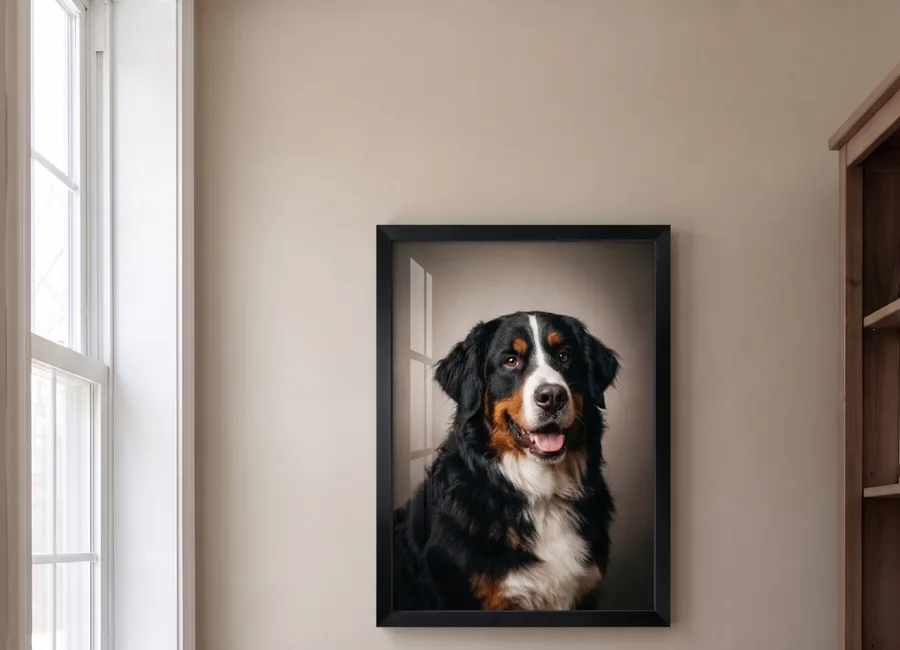
Gallery Wall Layout Ideas for 3 to 12 Frames
Gallery wall layout ideas for 3 to 12 frames, with real sizes, the gap to leave between frames, the height to hang at, and how to test it all on paper first.
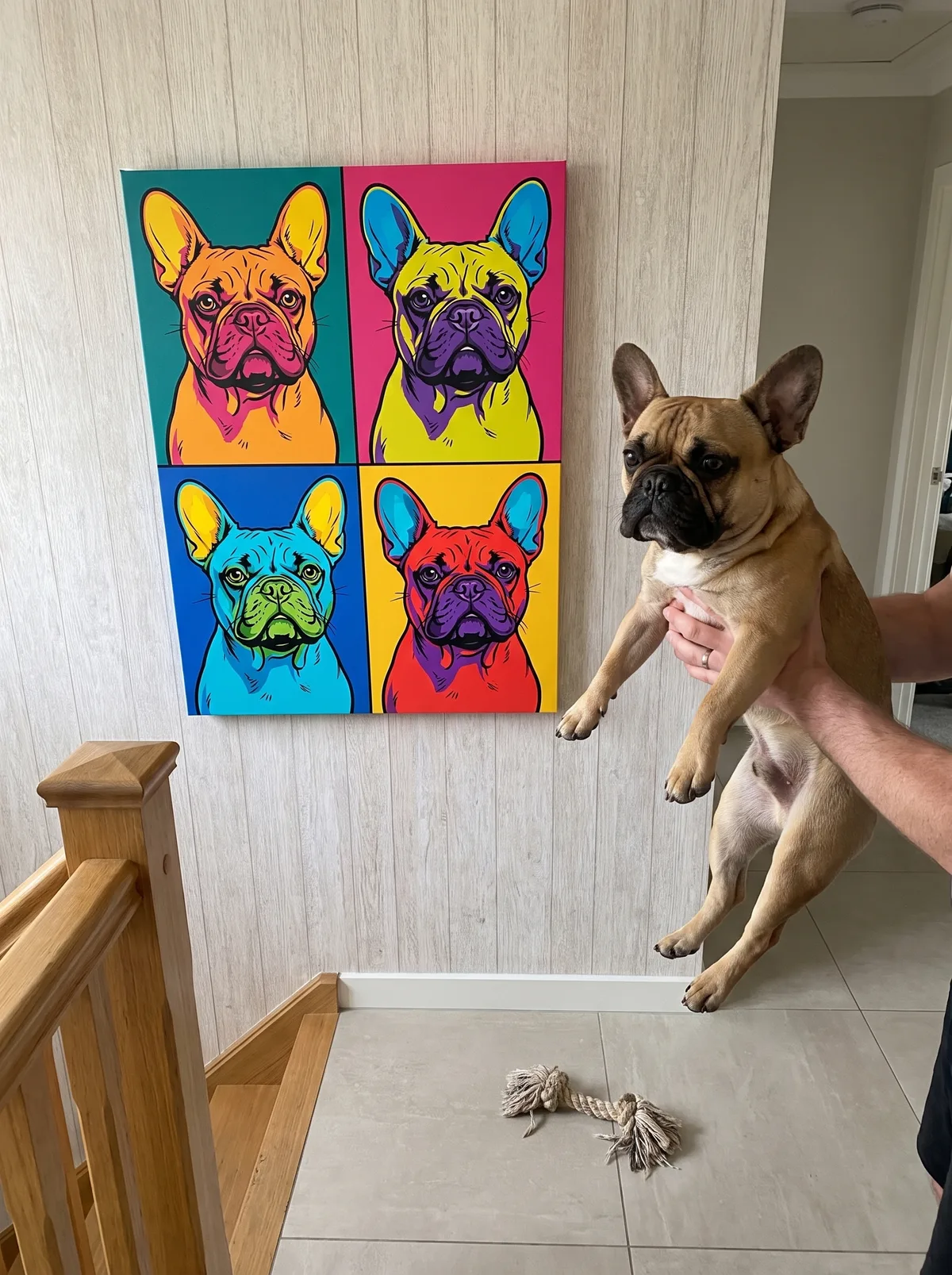
Staircase Gallery Wall: Plan and Hang It
Plan a staircase gallery wall step by step: find the stair angle, work out how far each frame steps up, keep even gaps and test with paper before you drill.